Showing posts with label culture. Show all posts

Tuesday, May 3, 2016

The exoticism Making Keris

KERIS1GRCLate night. A convoy of 15 men with white cloth bandage costume that keep running through the woods teak. Three men at the front carrying a jug, and some iron plates wrapped in cloth. Ten people carrying the torch in the back row.
A middle-aged man into cucuk lampah (leader sequence) are continuously sing the sekaran macapat (Javanese songs). The ambiance was so quiet, only the sound of footsteps and solemn chanting song of Java.
Dodot ira dodot ira/kumitir bedahing pinggir
dondomana jlumatana/kanggo seba mengko sore
mumpung padang rembulane/mumpung jembar kalangane
That is a ritual which is a series of processions making a dagger in Padepokan Brojobuwono in Wonosari, Karanganyar, Central Java. Previously held bancakan, that eating a variety of offerings that have been prayed for, such as rice cone, ingkung, red and white porridge, plantain, and snacks.
"This is the ritual prayer is performed each time we will start the procession of making a dagger. Similar carnival will still be held when the keris is finished, "said Teguh Basuki Yuwono, master-kris.
After the procession, the group straight into besalen (a keris). Basuki direct fire in besalen. Three male surrendered some iron plates, steel, and nickel is the main ingredient of making keris. Sparks immediately visible when iron plates inserted into the fireplace with fuel in the form of top quality teak wood charcoal. Forging process began.
"His name masuh, namely the process of cleaning the iron of their manure by means of forged repeatedly. Iron is clean when there is no more sparks, "said Basuki.
Once this process is completed, he added, the iron is ready to be forged. It takes between two to three months to complete a keris. To kris special orders can be even longer.
One artificial keris called Kyai Naga Basuki Minulyo completed within two years. Kris-making process takes a long time for special ingredients. One of them is the iron sand material taken from the slopes of Mount Merapi, mixed with iron and nickel selection.
But not always keris made from materials that complicated. He also experimented with materials rail lorries, per carriage, threaded steel bridges, and iron sand from the river in Kulon Progo.
"I want to prove that the keris nice it was not to be of a material that is expensive. The results are still quality. Keris seen shining with a clear prestige, "said Basuki.
During the first empire, the process of making a dagger held in secret and not just anyone can view. Besalen now very open to merteka who want to see the process of forging the iron until it becomes a keris.
But one thing has not changed, until now the whole process of making a dagger still be conducted with complex calculations. Basuki masters for example, still perform the ritual of fasting and praying to God until he felt got a clue when to make keris.
"Kris can not be made arbitrarily, because it involves self-pemesannya like weton (day of birth according to the calculation of Java). So keris ordered by someone to be different from one another booking kris because it involves the character of the buyer, "said Basuki.
In Solo, some besalen like Padepokan Brojobuwono, Dalem Hardjonegaran (Go Tik Swan), and belongs to the professor besalen Subandi frequented local and foreign tourists who want a close look at the process of making a dagger exotic.
The morning after the carnival simple, masters and panjak (assistant master) entered besalen. They began preparing keris making materials, such as iron where about 12 kilograms for a straight keris, or 18 kilograms for keris luk (grooved), steel about 600 grams, and prestige materials (nickel) approximately 350 grams. In ancient times, the best prestige material is meteor. But now the meteor has been very difficult to obtain.
Material prestige attached by means of two iron jaws, and then incorporated with forging resulting layers or folds berberselang alternating between iron and prestige.
For the manufacture of quality keris simple consisting of at least 128 folds. As for the quality of the required minimum number of 2,000 layers. The more folds automatically require a longer processing time.
Atmosphere besalen also looks busy. Masters and the panjak repeatedly enter the iron and nickel into the fireplace and then forge. Besalen air becomes hot. Ash flying between masters and panjak body sweat.
Once upon a time, the yellow-red iron plate gaping newly released from peperapian was immediately dipped in oil. This process is called nyepuh, namely iron hardened by sudden cooling. In this way, the iron becomes to be very strong and hard.
Later, after folding it up to hundreds or even thousands of times, making a dagger material such as iron, steel, nickel which can weigh tens of kilograms that could turn into a candidate dagger thin, lightweight, yet strong.
Kris was perfect candidate would be a keris, after going through the process of kinatah, which provide diverse ornaments on the bar with motifs of animals, plants, puppets, or rajah (mantra).
The final process of making a dagger is marangi (bring prestige), that is by putting arsenic (arsenic liquid water mixed with lemon juice) in the keris. Warangan will bring up the black coating on iron, nickel does not react so that the color is still white. The white color berbetuk specific pattern is called prestige. Price keris with good quality could reach tens of millions of rupiah and even hundreds of millions of rupiah.
Although including a stabbing weapon, but Basuki see that in ancient times the kris was made not merely to kill. Instead, keris first of all due to meet the needs of the ritual (spiritual).
"Keris as a weapon was only in the symbolic sense. Keris more as piyandel (trust and confidence). To increase confidence. Not to be worshiped or revered, "said Basuki.
According to observers from Solo kris, Ronggojati Sugiyatno, kris actually looked just like the look of puppets and batik. Because that is taken is the value of philosophy and life guidance.
"So depending on kadhewasaning Jiwa Jawi (maturity being). Someone is getting rich spiritual experience, the smarter you also understand the value of the philosophy of a dagger, "he said.
Ronggojati more see keris as the crowning achievement of wrought metal artworks bequeathed by past civilizations. Upon reaching the top, because the physical kris will find a blend of art forging, carving, sculpture, art form, as well as a symbol of art. Beyond the physical, keris is also always accompanied by the master's behavior, fasting, prayers, and rituals. (See also: Kris of Myth Becoming Art)
"Unesco recognizes the keris as a heritage or cultural heritage of the world not only because of his physical beauty, but also a complicated process of making a dagger, and the values ​​of philosophy in it," he said.
The basic principle of the keris is crease. All objects are thin much more powerful if it is made secdara bererlapis layers. This theory has been done by the ancestors of Indonesia in about the 12th century, long before the technology manufacture of plywood (plywood) recently discovered by Westerners in the early 16th century.
"I never doubted that the dagger was a crowning achievement of wrought metal artwork. One big if until now there are people who consider the kris as a heresy (mystic). Between myth (belief) and the mythical different, "Basuki said. (*)

Anatomy or Ricikan Keris Jawa

ricikan-keris

Gambar Ricikan Keris Jawa

GRC GRC - In Javanese kris contained details of the names used to refer to parts of the keris, the names were often referred to as Ricikan Keris. The names of these ricikan can be likened to that found in human anatomy, no hands, legs, chest, shoulders, head, and so forth.
There are so many types and shapes of keris, each form and type will typically have a different name. The simpler form of a keris, it will be a little too ricikannya. Simply put keris has three parts, namely wilahan (blades), parts of marijuana and pesi. Wilahan section can be divided into three, namely pucukan (the very sharp corner), crew-crew (kris body parts) and sor-soran (bottom kris). The names part of a keris most commonly found on the sor-soran keris. This is because the motifs and ornaments kris more are at the bottom / base of the keris.
ricikan-keris
Gambar Ricikan Keris Jawa
The names on the part of a keris are:
  1. Pesi, ie stalk dagger into the grip or carving.
  2. Cannabis, which is the basis of a keris thick. Ganya can be fused or separated by the bar.
  3. Aftermath Mimi, a tapered shape at the end of marijuana.
  4. Greneng, namely Java Dha-shaped ornament (like the letter W) are lined up.
  5. Thingil, the small protrusion on grenelig or on the basis of Java letter Dha.
  6. Ri pandhan, the tapered tip shape resembles a thorn in Dha Java letter.
  7. Ron Dha, namely ornaments on Dha Java letter.
  8. Sraweyan, namely the plains modestly behind sogogwi, over marijuana.
  9. Cauliflower, shaped like onions, located in the middle of the base bar and over ga ~ qa.
  10. Pejetan, shaped like a former massage thumb is located behind gandik.
  11. Lambe Elephants, shape resembles an elephant's lips. No duplicates and Ietaknya stick to gandik.
  12. Gandik, thickening slightly rounded shape is elongated and is located above the sirah lizards or end marijuana.
  13. Kembang Kacang, resembles an elephant's trunk and is located in the upper part gandik.
  14. Jalen, resembling a rooster spurs attached gandik.
  15. Tikel eyebrows, terietak above rnirip pejetan and shape eyebrows.
  16. Leaf, form the ridge between two bribes.
  17. Bribe front, the shape of the groove and an extension of the pejetan.
  18. Bribe rear, shape groove which is located on the back.
  19. Pudhak sategal, a pair of sharpened form that came out of the bar left and right.
  20. Poyuhan, forms a thickened at the end of the bribe.
  21. Landep, which is part of the sharp keris.
  22. Gusen, located in Be! Akang landep, elongated shape of sor-soran until shoots.
  23. Milir sugar, elevated shape among Gusen and kruwingan.
  24. Kruwingan, plains terietak on the left and right-adha adha.
  25. Adha-adha, thickening in the middle of the bar from the bottom to the top sampal.

Friday, February 5, 2016

Enjoy the splendor of Borobudur Temple


GRC - Borobudur is a giant monument inspired virtues that built colossal navel Java Island for over 75 years and was finished in the year 825 AD in the reign of King Smaratungga. Borobudur was buried in history for over 1,000 years before it was revealed back, restored, and is now recognized as a UNESCO's World Heritage site no. 592 and listed in Guinness World Records as the largest Buddhist archaeological sites in the world.

So far, we know of Borobudur as a magnificent historical monuments, bustling tourist attraction, and many country Indonesia. In fact, the world's largest Buddhist temple was built not just for tourism or emblem of triumph, but rather it is to pass on and preserve the noble values of virtue.

Not only the magnificent and large, wall sculptures Borobudur filled 2672 relief panels which, when arranged in rows will reach a length of 6 km! It is hailed as the largest ensemble of Buddhist reliefs and comprehensive in the world, unsurpassed in artistic value.

Reliefs carved on the walls of the temple is divided into 4 main story that is Karmawibangga, Lalita Wistara, Jataka and Awadana, and Gandawyuda. Besides tells about the life of the Buddha and his teachings, these reliefs also record the progress of the Java community at that time. Evidence that the ancestors of the Indonesian nation is an accomplished sailor and tough can be seen in 10 relief ships. One of the relief ship as a model in making replica ships that used to sail The Cinnamon Route from Java to the African continent. Currently referred to as a replica of the ship that was kept in the Borobudur Ship Museum Samudra Raksa.

To follow the flow of the fabric of the story carved on temple walls, visitors have to walk around the temple clockwise or known as circumambulation. Enter through the east door, walk clockwise to the position of the temple is always on the right, until arriving at the east stairs and stepped up to the next level. This is done repeatedly until all levels passed and is in the top of the temple-shaped stupa. At the top, lift up the view in any direction it will show a row of Menoreh Hills, Mount Sindoro, Cleft Mountain, Mount Merapi and Mount Merbabu upright around the temple. The mountains and hills as if a guard that guarded existence of Borobudur Temple.

Based on the inscriptions Kayumwungan 824 dated May 26, Borobudur was built by King Samaratungga between the 8th century to the 9th century, coincided with Mendut and Pawon. The development process lasted for 75 years under the leadership of architect Gunadarma. Although not familiar with computers and other advanced equipment, Gunadarma able to implement the interlock system in the construction of the temple. A total of 60,000 cubic meters, amounting to 2,000,000 andesite stone block that was carried from Elo and Progo sculpted and assembled into a giant puzzle that covers a small hill to form Borobudur.

Borobudur not only have very high artistic value, masterpiece which became evidence of human civilization in the past is also loaded with philosophical values. Carrying the concept of mandala symbolizing the universe cosmology in Buddhism, this magnificent building is divided into three levels, namely the world desire or lust (Kamadhatu), the world of forms (rupadhatu), and a world without form (Arupadhatu). If seen from a height, like fried lotus Borobudur temple on the hill. The walls of the temple which is in Kamadatu levels and Rupadatu as flower petals, while a row of circular stupa at the Arupadatu into stamens. Parent Stupa symbolizes the Buddha, so the whole Borobudur depict Buddha sitting on lotus petals.

Enjoy the splendor of Borobudur is not just enough to walk down the hallway and go up to the top level of the temple. One thing that should not be missed is witnessing Borobudur Borobudur Sunrise and Sunset from the top of the temple. Showers of the morning sun hit the stupas and Buddha statues made of majesty and grandeur of the temple is more pronounced. While standing on top of the temple at dusk along a row of stupas and watch the sun slowly began shade will create a feeling of calm and peace.

Monday, February 1, 2016

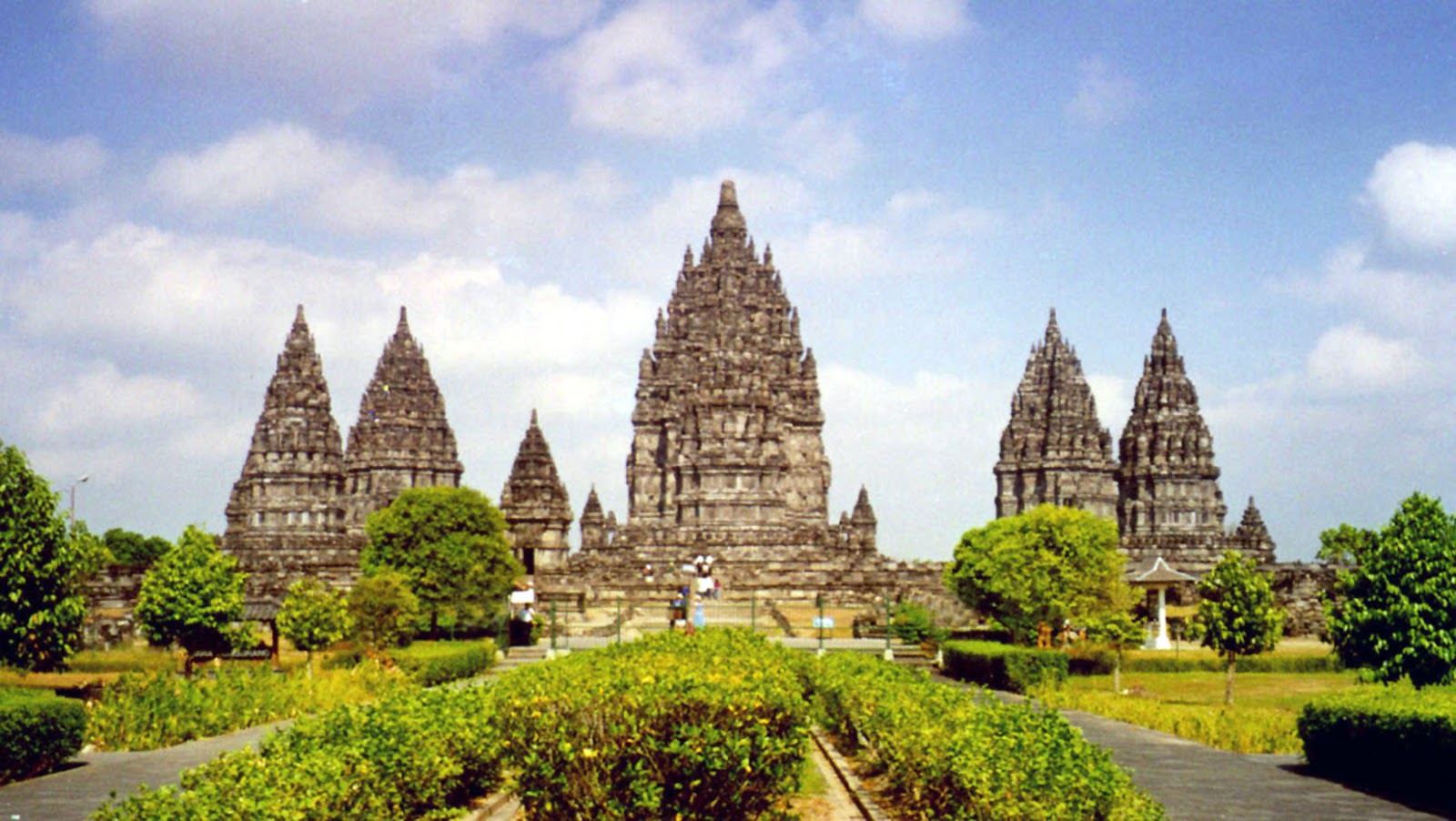
PRAMBANAN TEMPLE "BEAUTIFUL HINDU TEMPLE IN THE WORLD"


GRC - Prambanan is extraordinarily beautiful building built in the 10th century during the reign of two kings, and Rakai Rakai Pikatan Balitung. 47 meters tall (5 meters higher than Borobudur temple), the foundation of this temple has fulfilled the desire of the founder to show Hindu triumph in Java. This temple is located 17 kilometers from the city center, in the middle of the area that is now a beautiful park.

There is a legend that the Java community has always told about this temple. Once upon a time, a man named Bandung Bondowoso love Jonggrang. Because of his love, Jonggrang asked Bondowoso make 1000 temples with statues in one night. The request was nearly fulfilled Jonggrang asked the villagers to pound rice and make a big fire that created an atmosphere like the morning. Bondowoso who only completed 999 statues cursed Jonggrang into the statue-1000 because he felt cheated.

Prambanan temple has three main temples in the main yard, namely Vishnu, Brahma and Shiva. The third temple is the epitome of Trimurti in Hindu belief. The third temple is facing east. Each main temple has accompanying temple facing to the west, namely Nandini for Shiva, Swan to Brahma, and Garuda for Vishnu. In addition, there are two temples wedge, 4 color temples and 4 corner temples. Meanwhile, the second page had 224 temples.

Entering the Shiva temple located in the middle and the highest building, you will find a room 4.. One main room contains a statue of Shiva, while the other 3 rooms each containing a statue of Durga (Shiva's wife), Agastya (Shiva's teacher), and Ganesha (son of Shiva). Durga is touted as the statue Jonggrang in the legend above.

Vishnu Temple, located in the north of the temple of Shiva, you will only see one room containing a statue of Vishnu. Brahma temple, which is located south of Shiva temple, you will only find one room with a statue of Brahma.

Quite attractive accompanying temple is Garuda temple that is located near the Vishnu temple. This temple keeps a story of half-bird human being named Garuda. Garuda is a mystical bird in Hindu mythology, who was gold, white face, red wings, beak and wings like eagles. It is estimated that the figure is Hindu adaptation of Bennu (means 'rises' or 'shining', usually associated with the god Re) in ancient Egyptian mythology or Phoenix in Old Greek mythology. Garuda can save his mother from the curse of Aruna (Garuda's handicapped brother) by stealing Tirta Amrita (holy water of the gods).


The ability to save that which is admired by many people until now and are used for various purposes. Indonesia used to sign the country. That said, the creator of the Garuda Pancasila find inspiration in this temple. Other countries also use it to sign the country is Thailand, with the same reason but adaptation forms and different appearance. In Thailand, Garuda is known as Pha recruited or recruited.

Prambanan also has panels of relief describing the story of Ramayana. According to experts, the relief is similar to the Ramayana story is revealed through oral traditions. Another interesting relief is Kalpataru tree that the Hindu religion is considered as the tree of life, sustainability and environmental compatibility. In Prambanan, relief Kalpataru trees flanking a lion depicted. The existence of this tree makes experts consider that the 9th century have wisdom in managing the environment.

Just like Garuda, Kalpataru is now also used for various purposes. In Indonesia, Kalpataru became a symbol Forum for Environment (WALHI). In fact, some scientists in Bali to develop the concept of Tri Hita Karana for environmental conservation by seeing Kalpataru relief in this temple. The tree of life can also be found in the mountains that used to open the puppet arts. A proof that relief panels in Prambanan has worldwide.

If careful, you can also see various birds relief, this time a real bird. Bird reliefs at Prambanan so natural that biologists can identify their genus. One of these reliefs Yellow-crested Cockatoo (Cacatua sulphurea) that invites questions. Why the bird was actually only in Masakambing Island, an island in the Java Sea. Then, what kind it was once numerous in Yogyakarta? Please find out the answer yourself. Because, until now no one who can solve the mystery.

Well, there are many more that can be extracted at Prambanan. You should not be tired of course. If it was finally exhausted, you can relax in the garden around the temple.

Sunday, January 31, 2016

The Birth of Hanuman


In the story the movie Hanuman was born in the Java language is told about the birth of Hanuman Anjani. The story begins when Anjani associated with the Wind. How the story of the birth of the figure described as a white monkey / ape white? Immediately, we see the story in the Java language below.

Hanuman was born during the Treta Yuga was the son of Anjani, female monkeys. Formerly Anjani is an angel, a name Punjikastala. One because the curse, she was born into the world as a jungle female. The curse can be dispersed if a son of her maternal which is incarnation of Shiva. Anjani married Kesari, a jungle camp. Together with Kesari, Anjani each other to do what Ben Shiva Shiva incarnate sakanggo son refused them.

Because Shiva was impressed with the worship of Anjani and do Kesari, she granted them down into the world to be Hanuman.

One version has it that if a fitting penance Anjani worship Shiva, in the second place, King Dasaratha perform Yajna to Putrakama not decreasing. Strayeth, she received a number of foods served to the husband, he was in the maternal Rama, Lakshmana,

Bharata and Satrugna. High interest gods, grab a bird was fed, and dropped her in a high pedestal where Anjani meditate again. Bayu, the god of wind, tilt the Fed Ben arrived in the hands of Anjani. Anjani eat these, they come Hanuman.

Hanuman approached Rama-Sita-laksmanasa one version says that Hanuman was born accidentally, because the relationship between Marc and Anjani. Told that on one day, god Bayu see Kayon Anjani, and then she hugged him. Anjani angry because he felt harassed. But God replied that Bayu Anjani not want tarnished demo of the Wind.

She hugged Anjani not in himself, but it was his heart. Bayu also said that the upcoming Anjani maternal going a son that his equal with the Wind and the most intelligent among the jungle.

Similarly, told the story of Hanuman in the movie are very famous. Later, Hanuman became brothers in the fight against the Pandavas wrath

Sunday, November 23, 2014

BOROBUDUR ARCHITECTURAL MASTER PIECES 9Th CENTURY

Long before Angkor Wat in Cambodia stand and the great cathedrals in Europe, Borobudur has stood proudly in Java. Building called UNESCO as monuments and the grandest stupa complex as well as the world's most visited by pilgrims in the mid-9th century until the early 11th century. Buddhists who want to get enlightenment flocked from India, Cambodia, Tibet, and China. Not only is magnificent and large, wall sculptures Borobudur met in 2672 that if the relief panels arranged in rows will reach a length of 6 km! It is touted as an ensemble of Buddhist reliefs largest and most comprehensive in the world, unsurpassed in artistic value.

Reliefs carved on the walls of the temple is divided into 4 main story that is Karmawibangga, Lalita Wistara, Jataka and Awadana, and Gandawyuda. Besides tells about the life of the Buddha and his teachings, the relief also record progress Java community at that time. Evidence that the ancestors of the Indonesian nation is an accomplished sailor and tough can be seen in 10 relief ships. One of the relief ship used as a model in the making replica ships that used to sail the Cinnamon Route from Java to the African continent. Currently replica ship called Borobudur Ship Museum was stored in Ocean Mercury.

To follow the flow of the fabric of the story that were inscribed on the walls of the temple, visitors must walk clockwise around the temple, known by the term circumambulation. Enter through the east door, walk clockwise to the position of the temple is always there on the right, until arriving at the east stairs and stepped up to the next level. This is done repeatedly until all levels are exceeded and in the top of the temple-shaped stupa. At the top, lift up the views in all directions it will show row Menoreh Hills, Mount Sindoro, Sumbing, Mount Merapi, and Merbabu that stands around the temple. Mountains and hills as if a guard who fortify the existence of Borobudur.

Based Karangtengah inscription dated on 26 May 824, Borobudur was built by King Samaratungga between the 8th century until the 9th century, together with Mendut and Pawon. The development process lasted for 75 years under the leadership of architect Gunadarma. Although not familiar with computers and other advanced equipment, Gunadarma able to implement the interlock system in the construction of the temple. A total of 60,000 cubic meters of andesite, amounting to 2,000,000 blocks of stone were brought from Elo and Progo River sculpted and assembled into a giant puzzle that covers a small hill to form Borobudur.

Borobudur not only have a very high artistic value, masterpiece which is evidence of human civilization in the past is also loaded with philosophical value. Carrying the concept mandala symbolizes the universe cosmology in Buddhism, this magnificent building is divided into three levels, namely the world desire or lust (Kamadhatu), the world form (rupadhatu), and a world without form (Arupadhatu). When viewed from a height, like fried lotus Borobudur Temple on the hill. The walls of the temple which is at the level Kamadatu and Rupadatu as flower petals, while a row of circular stupa at the level Arupadatu into stamens. Parent stupa symbolizes the Buddha, so the whole Borobudur depict Buddha was sitting on lotus petals.

Enjoy the grandeur of Borobudur is not just enough to walk down the hallway and go up to the top level of the temple. One thing that should not be missed is witnessing Borobudur Borobudur Sunrise and Sunset from the top of the temple. Showers of the morning sun hit stupas and statues of Buddha made the majesty and grandeur of the temple is more pronounced. While standing at the top of the temple at dusk along the row of stupas and watch the sun slowly began to shade will create a feeling of calm and peace.